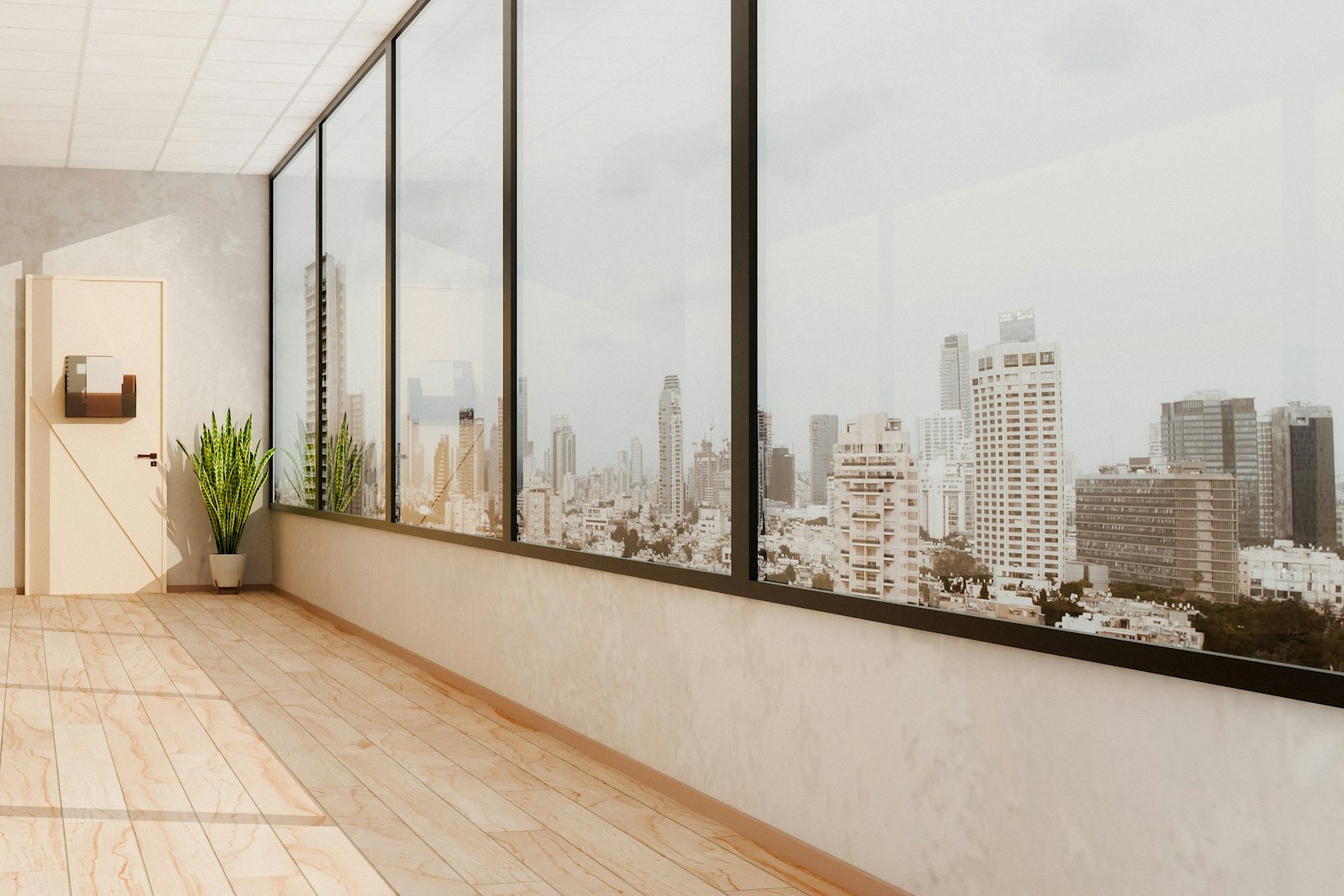
Begin with the conditions
Most office plants do not die from neglect alone. They die because they were placed in conditions they were never suited to. A plant chosen from a nursery under bright shade is moved to a desk twelve metres from the nearest window, beneath an air-conditioning grille, and left without water from Friday evening to Monday morning.
Indian offices add their own pressures. Air-conditioning runs for long hours and dries the air. Dust settles on leaves, particularly during the dry months before the monsoon and in buildings near construction. Windows are often tinted or covered by blinds to control heat. And on long weekends and festival holidays, the office may be empty for several days.
Selecting plants that tolerate these conditions, and placing each where its needs can be met, matters more than choosing the most attractive species.
Map the floor into light zones
Walk the office and divide it into broad light zones. A simple method is to stand at each position at midday and observe whether you could comfortably read a printed page without artificial light.
- Bright indirect light: within two or three metres of a large window, but not in direct sun for long periods.
- Medium light: further into the room, where daylight is noticeable but soft.
- Low light: the deep interior, far from glass, relying mainly on artificial light.
Direct afternoon sun through a west window can scorch many indoor plants, so treat the area immediately against such glass with care. Record the zones on a plan. This becomes the basis for choosing and placing each plant.
Choose plants by zone
Several plants are commonly used in offices because they tolerate indoor conditions reasonably well. Each has particular needs.
For low and medium light
- Pothos, widely known in India as the money plant, is a trailing vine that tolerates low light and irregular watering. It grows faster and fuller with more light.
- Snake plant (Dracaena trifasciata, formerly Sansevieria) stores water in its stiff, upright leaves and copes with dry air and missed watering. Overwatering is the main risk.
- ZZ plant (Zamioculcas zamiifolia) grows from water-storing rhizomes and tolerates low light and long dry periods. It is slow-growing and suits a planter that will not be moved often.
- Peace lily (Spathiphyllum) manages in medium to low light but needs regular watering; its leaves droop visibly when dry, which makes it a useful indicator.
For bright indirect light
- Areca palm (Dypsis lutescens) needs good light and regular watering. In low light it yellows and thins.
- Rubber plant (Ficus elastica) has large, glossy leaves that show dust readily. It needs bright light and occasional wiping.
- Philodendrons and monstera grow well near windows with filtered light and enough space to spread.
Check a plant's toxicity if it will be near pets or children, as some common species, including pothos and peace lily, are mildly toxic if chewed.
Pot for drainage and size
The container matters as much as the plant. Pots must have drainage holes, with a saucer or an inner pot set inside a decorative planter, so that water does not collect at the roots. Waterlogged soil kills more office plants than dryness.
Choose a pot large enough to hold moisture over a weekend but not so large that soil stays wet for weeks. A well-draining potting mix, often including cocopeat and perlite or coarse sand, suits most indoor species. Self-watering planters with a reservoir can help in offices where watering is irregular, but they still need checking.
Consider the weight of large planters on raised floors and the need to move them for cleaning. Castors under heavy pots make this easier.
Plan maintenance before planting
Plants require regular care: watering, wiping dust from leaves, removing dead growth, checking for pests and occasionally rotating them towards light. In a busy office this is rarely anyone's job.
A maintenance contract with a local nursery or plant service is often the most reliable approach. A service visits weekly or fortnightly, waters, cleans and replaces plants that have declined. Agree on the scope, the frequency and the replacement terms in advance. If staff will care for plants themselves, assign responsibility clearly and arrange cover for holidays.
Be honest about air quality
Plants are often promoted as natural air purifiers. The claim is commonly traced to a NASA study from 1989 that tested plants in small sealed chambers. A later review by Cummings and Waring, Potted plants do not improve indoor air quality, published in the Journal of Exposure Science & Environmental Epidemiology in 2019, analysed the published research and concluded that the effect in real buildings is negligible compared with ordinary ventilation.
In practice, clean indoor air comes from good ventilation, filtration and controlling sources of pollution. Plants are worth having for their appearance, their softening effect on a room and the sense of care they bring. They should not be relied on to clean the air.
Start with a few and learn
Rather than filling the office at once, begin with a small number of robust plants placed in well-understood light zones. Observe how they fare over a few months, then add more. The most useful step is simply mapping the light and matching plants to it.