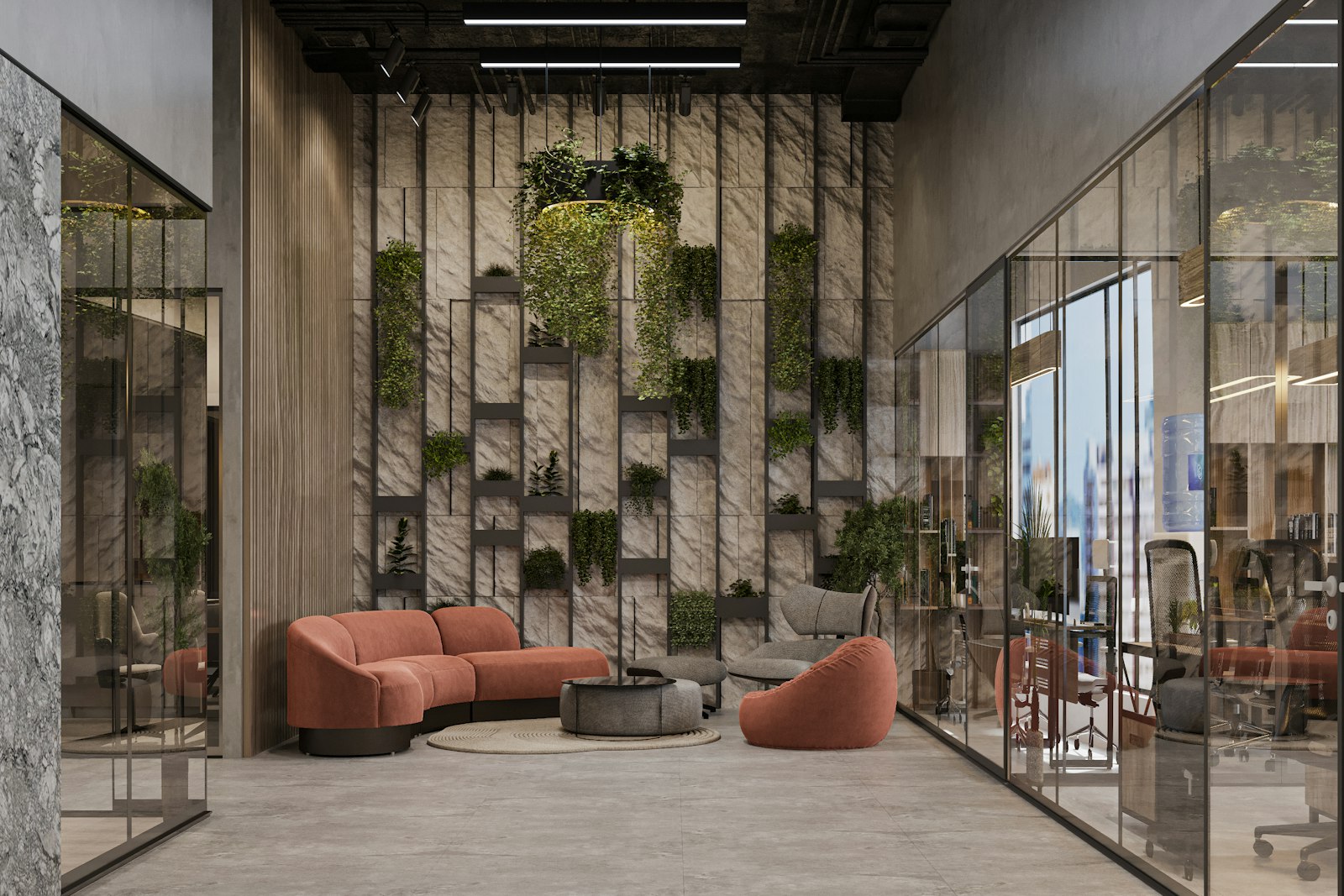
Look past the pot plant
Biophilic design is often reduced to a planter in the corner or a green wall behind reception. Plants have their place, but the idea is broader. It draws on a long-observed tendency for people to feel more at ease in surroundings that echo the natural world: changing light, fresh air, a view to a horizon, the texture of wood or stone, the sound of water.
A useful framework comes from the consultancy Terrapin Bright Green, whose report 14 Patterns of Biophilic Design (2014) groups these qualities into three families: nature in the space, natural analogues and the nature of the space itself. The report describes patterns rather than prescriptions, and it is honest that the research behind each varies in strength. It is best read as a vocabulary for design decisions, not as a promise of measurable health outcomes.
What follows applies that way of thinking to the realities of an Indian office.
Protect views out
A view to the outside world, whether of trees, sky, the street or a distant skyline, is one of the simplest connections to nature an office can offer. It gives the eyes a long focal distance after hours at a screen and keeps people aware of time and weather.
Views are lost through decisions made early in planning. Enclosed cabins along the façade, tall storage units, frosted glass and permanently drawn blinds all block them. Keep the perimeter open where possible, use low furniture near windows and place enclosed rooms towards the core. Where a view is poor, a planted terrace, balcony or even a well-planted window box can give the eye something living to rest on.
Let daylight and air change
Daylight is valuable not only for its brightness but for the way it changes across the day and the seasons. Morning light is cool and soft, afternoon light warmer and stronger; the monsoon brings diffuse, grey days. People notice these shifts even indoors, and they help mark the passage of time.
Design to admit daylight while controlling glare and heat. In Indian cities, west and south façades receive intense sun for much of the year. External shading, deep window reveals, light shelves and adjustable blinds allow daylight in without making desks uncomfortable. Pale ceilings and walls carry light deeper into the floor plate. Where artificial lighting supplements daylight, controls that respond to available light preserve some of the natural variation rather than flattening it.
Use materials that show their nature
Natural materials carry a sense of origin: the grain of wood, the veining of stone, the irregularity of handmade tile, the weave of cotton or jute. They also age visibly, gaining character rather than simply wearing out.
India has a deep tradition of such materials and the trades that work them. Solid timber, cane and rattan, kota and other local stones, terracotta, lime plaster and handloom textiles can all be used in contemporary offices. Choose finishes that can be touched: a timber handrail, a stone counter, a fabric panel. Where natural materials are impractical, honest alternatives with real texture serve better than glossy printed imitations.
Most offices are held at one steady temperature, with the same air everywhere. Natural environments are rarely like that: a breeze, a patch of shade, a warmer spot in the sun. Some subtle variation can make a space feel more alive.
This does not mean abandoning comfort. It can mean an operable window in a breakout area for the cooler months, a ceiling fan in a semi-outdoor terrace, a shaded verandah for tea breaks, or simply allowing slightly different conditions in different zones. Good ventilation with fresh air matters more than any decorative element. Be careful in dusty or polluted conditions; filtered fresh air is better than an open window on a busy road.
Shape space for prospect and refuge
People tend to feel comfortable in places where they can see out across a space while having something at their back: a high-backed seat facing an open floor, an alcove beside a window, a mezzanine overlooking a lower level. This combination is often described as prospect and refuge.
Office layouts can offer both. Place quiet seats in sheltered corners with a view across the room. Use partial screens, planting or shelving to create semi-enclosed areas within open plans. Vary ceiling heights so that lower, more intimate zones sit alongside taller, more open ones.
Introduce water and natural patterns carefully
The sound or sight of moving water can be calming, and natural patterns, such as the branching of trees, the rhythm of leaves, the ripples of sand, appear in textiles, screens and carvings across many cultures. Both can enrich an interior.
Water features need maintenance, consume power and, in humid climates, can encourage mosquitoes if not well kept. A small, well-designed feature in a reception or courtyard may justify the care; a large one rarely does. Natural patterns are easier: a jali screen, a carved timber panel or a textile with organic forms brings the same quality without the upkeep.
Treat it as a design approach
Biophilic design works best as a way of looking at every decision, rather than a feature added at the end. Ask, at each stage, whether a choice connects people to light, air, material and view, or separates them from it. The questions are simple enough to bring to any brief.